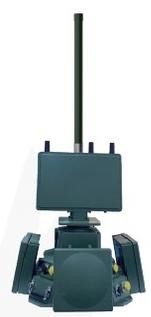
The anti-UAV system is a dedicated UAV defense system for key areas. It is developed to counteract acts such as delivery of hazardous materials and unauthorized filming of supervised facilities carried out by UAVs. By detecting, countering and inducing UAVs within the protected airspace, the system prevents unauthorized UAVs from entering core protected zones.
This UAV defense system is widely deployed in various scenarios with high security requirements, including but not limited to supervised premises and confidential vital sites, high-end corporate parks, as well as private territories for privacy and security protection. It effectively addresses potential UAV intrusions and threats through precise UAV detection, identification and countermeasures, so as to safeguard airspace security.
3. Low-Altitude Economy Solution
The low-altitude economy is booming, with radar technology serving as one of its core supporting technologies and playing an indispensable role. With the popularization of UAV technology and the growth of low-altitude flight activities, radars have seen expanding applications in low-altitude surveillance, anti-UAV systems, meteorological detection, air traffic control and other fields. Capable of actively detecting and identifying low-altitude flying targets, radar technology ensures flight safety and enables networked low-altitude security monitoring, making it a vital component of the low-altitude security system.
Adopting phased array technology, the system develops X-band, C-band and S-band radars tailored to different application scenarios. It achieves accurate detection, monitoring, tracking, navigation, positioning, management and guidance of low-altitude, low-speed and small-size targets, delivering solid technical support for the safe and efficient operation of low-altitude airspace.
• Long detection range: Equipped with advanced radar technologies and optimized frequency band selection, the integrated sensing and communication radar system can accurately detect aircraft at long distances, leaving sufficient response time for low-altitude airspace management.
• All-time and all-weather operation: Maintains stable detection performance under all weather conditions, clear or severe.
• Wide airspace coverage: Phased array technology enables flexible beam scanning across the entire airspace, realizing full coverage of low-altitude zones.
• Detection of low-altitude, low-speed and small-size targets: Accurately detects small low-altitude flying objects such as UAVs and birds to guarantee flight safety.
• Monitoring and tracking: Tracks the real-time position and movement of aircraft to provide administrators with precise data support.
• Navigation and positioning: Delivers high-precision navigation and positioning services for aircraft to ensure accurate and safe flight routes.
• Airspace management and guidance: Assists administrators in orderly low-altitude airspace governance, guides aircraft to fly along preset routes and avoids aerial traffic conflicts.
 Public Security Filing Number:辽公网安备21060302000305号


