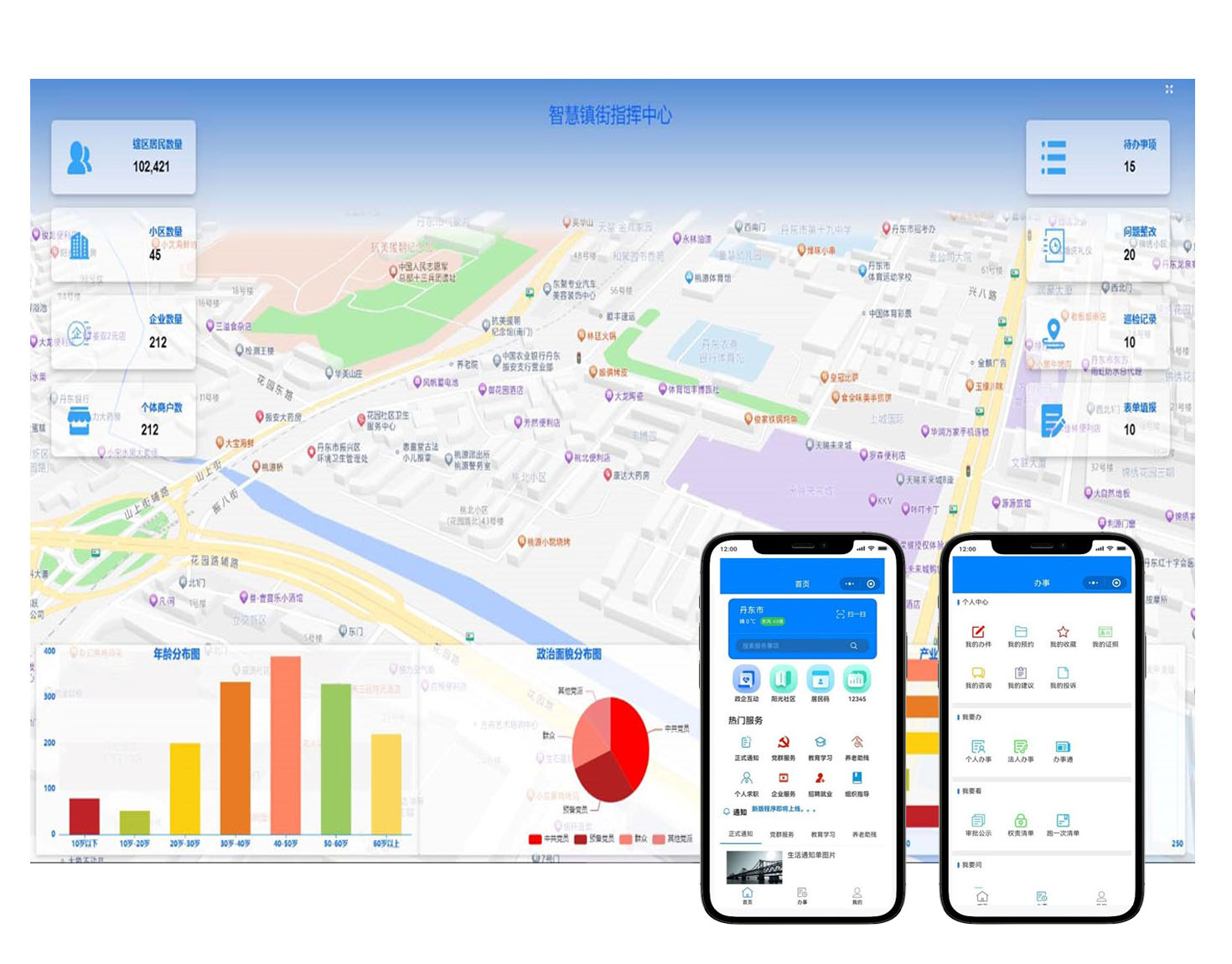
Definition of Smart Town and Sub-district Informatization Construction
Based on geographical areas including sub-districts, towns and villages, smart town and sub-district informatization construction leverages information technology to integrate community resources. It delivers efficient, convenient and smart services to residents, and improves residents’ experience and sense of satisfaction with smart cities.
I. Core Problems Solved by the Smart Town & Sub-district Informatization Platform
1. Fully meet residents’ demands in daily life, work and entertainment, and build a comfortable, convenient and harmonious homeland.
2. Boost communication among residents, strengthen neighborhood mutual assistance and community cohesion.
3. Reinforce community management, elevate community governance capacity and improve the quality of public services.
4. Support networked alarm management to provide safety services for residents.
5. Adopt innovative technological tools to build smart communities, offer more intelligent services for residents and raise the intelligence level of communities.
6. Deliver supporting services for home-based elderly care.
II. Architecture & Functional Description of the Smart Sub-district Informatization Platform
1. Realize collaborative information sharing across the platform, and provide a unified backend for community users, property management staff and administrators to operate various services. The platform supports PC terminals, mobile terminals, multimedia large-screen displays and other devices.
2. Enable access to IoT applications such as smart public facilities and smart public environment monitoring. It supports secondary encapsulation of these applications to deliver customized solutions for diverse demands.
3. Provide core capabilities and supporting services for application development, testing and operation, including IoT access services, data management & services, and application support services.
4. Implement operation and maintenance guarantee for the whole system, monitor the platform’s operation and maintenance process, and secure platform performance and service quality.
5. Supply computing, network and storage resources essential for platform operation.
6. Composed of IoT sensing devices including sensors, electronic tags, sensor nodes, communication modules and IoT development boards. Core technologies involved cover radio frequency technology, advanced sensing technology, wireless network networking technology and field bus control technology.
III. Advantages of the Smart Town & Sub-district Informatization Platform
1. Full Community Overview on One Map
Visually display the location and distribution of sub-districts, buildings, facilities and other elements. Combined with data visualization and GIS technology, it presents information including key personnel, key incidents, key enterprises, community components and grid divisions on a single map.
2. One-click Comprehensive Decision Analysis
Adopt big data technology to connect the four-level governance framework. All departments and administrative levels can conduct comprehensive analysis on registered population, geographic information and community work data.
3. Integrated Network Covering Five-tier Ecosystem
Link municipal/district, town/sub-district, village/community and residential compound levels to build an open community-centric ecosystem.
4. One-stop Livelihood Services for Residents
Deliver one-stop convenient services including government affairs handling and daily life services.
5. Single Terminal for Anytime, Anywhere Access
Equip staff with user-friendly mobile terminals, enabling off-hours and off-site remote office work.
6. Integrated Coverage of All Business Modules
Form unobstructed communication channels across multi-level governance. It supports work reporting and data submission to higher authorities, as well as data access and service supervision for subordinate units.
7. Customizable Smart Form Builder
Allow users to create personalized form templates on demand to facilitate data collection and sorting.
IV. Core Functions of the Smart Town & Sub-district Informatization Platform
Display real-time indicators and status of grassroots communities via charts, maps, animations and other forms. Users can view and manage community conditions anytime and anywhere through large screens, computers or mobile phones.
2. Community Government Service Module
Support residents to process public affairs and submit consultations. The government service portal offers convenient consultation channels and online business processing, enabling residents to access policy and regulatory information in a timely manner.
3. Community Work Management Module
Conduct comprehensive statistical analysis of six core community elements: residents, incidents, physical assets, geographic locations, public opinions and organizations. Multi-dimensional charts visualize community data distribution to support emergency response and public safety management.
Provide diverse convenient services and a resident mutual aid platform. Residents can share resources, experience and mutual assistance information, and access housekeeping, healthcare, legal consultation, job recruitment and other services.
A brand-new smart party building system integrating publicity, management, education and services. Featuring intelligence, platformization and full digitalization, it empowers party building work with information technology, realizes precise management and intelligent support, consolidates the foundation of party building administration and refines party building operations.
6. Community Elderly Care Supervision Module
Perform statistical analysis on elderly population data to track senior population growth trends, health status and care dependency levels. Information technology enables remote monitoring, door-to-door services, safety early warning, emergency support and maintenance services for home-based seniors, forming an elderly care service circle.
Apply intelligent technologies to public services to build a more convenient, efficient and smart living environment for residents.
Digitize, automate and network property management to realize intelligent property services, including smart access control, video surveillance and parking lot management systems.
 Public Security Filing Number:辽公网安备21060302000305号


