In current enterprise operation and public administration, asset scales keep expanding with increasingly diverse asset categories. Traditional asset management models are plagued by numerous pain points. Manual asset information registration is prone to erroneous or missing records, creating discrepancies between recorded asset data and physical reality. Asset inventory relies on manual one-by-one verification, which is extremely inefficient, labor-intensive, and unable to guarantee high accuracy. Real-time tracking is unavailable when assets shift locations dynamically, leading to asset loss or idle waste. A full-lifecycle asset management mechanism is absent, making it difficult to precisely control all stages including asset procurement, usage, maintenance and retirement, and hindering optimal resource allocation and cost control. To address the above challenges, it is imperative to build a digital asset management system leveraging RFID technology.
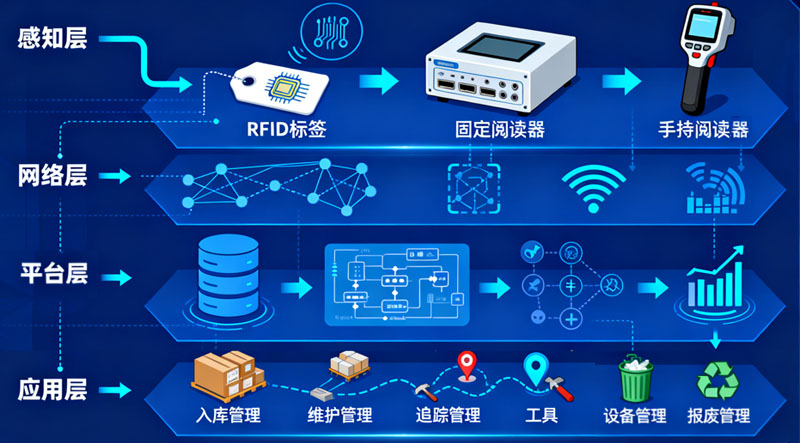
As the fundamental carrier for system data collection, the perception layer consists of two core devices: RFID tags and RFID readers, undertaking the critical function of primary asset information gathering.
• RFID Tags: Each tag stores a unique asset identifier and core attribute data. Asset information is written into tags via dedicated encoding equipment, after which tags are affixed or fixed onto corresponding physical assets, granting every asset a digital identity that enables identification and traceability.
• RFID Readers: Classified into fixed readers and handheld readers.
a. Fixed readers: Deployed at asset inbound/outbound passages, key storage zones and other core locations. They automatically identify tag information of assets passing through the area, enabling automatic inbound/outbound registration and real-time asset location monitoring, with data collection completed without manual intervention.
b. Handheld readers: Portable for staff to carry, applicable to mobile scenarios such as asset inventory, on-site asset information inquiry and data update. Featuring portability and user-friendly operation, these devices support offline working mode: collected data can be stored locally when offline and automatically synchronized to the system platform once network connectivity is restored, ensuring uninterrupted data acquisition in complex working environments.
The network layer transmits asset data collected by the perception layer to the platform layer, with core objectives of stable, real-time and secure data transmission. The system adopts a hybrid deployment of wired and wireless networks:
• Fixed readers connect to enterprise LAN or the Internet via Ethernet to deliver high-speed and stable data transmission for fixed areas;
• Mobile terminals such as handheld readers interact with the system platform over wireless networks to support real-time data upload and command reception for mobile scenarios.
Serving as the core hub of the entire system, the platform layer undertakes key functions including data storage, processing, analysis and business logic handling, providing robust technical support for upper-layer applications.
It adopts a hybrid storage architecture combining relational and non-relational databases:
• Relational databases store structured data such as basic asset information, transaction records and user profiles, ensuring complete data relevance and efficient query performance;
• Non-relational databases store massive raw RFID data, asset images, maintenance videos and other unstructured data, meeting scalability requirements for large-scale data storage and delivering high-efficiency, flexible overall data storage.
It cleans, filters, integrates and converts raw data transmitted from the perception layer. Algorithms eliminate redundant data and correct erroneous entries, converting scattered heterogeneous data into standardized valid data to supply high-quality, reliable data for subsequent data analysis and business applications.
3.3 Business Logic Processing Module
It embeds core business logic covering the full asset management workflow, standardizing operations including asset warehousing, outbound transfer and maintenance to guarantee standardized and compliant asset management.
Big data analytics technology conducts multi-dimensional in-depth analysis of asset data, covering asset quantity statistics, value evaluation, usage frequency analysis, idle rate calculation, maintenance cost accounting and other dimensions. Visual analysis reports convert data insights into intuitive decision-making references, helping management teams accurately grasp asset operation status.
The application layer delivers diversified functional applications to users of different roles via multi-terminal access including Web and mobile terminals, fully covering all asset management scenarios.
4.1 Asset Warehousing Management
After asset procurement, staff scan asset tags with handheld readers; the system automatically retrieves and cross-verifies purchase order data. Upon data matching, the system completes automatic warehousing registration, generates standardized warehousing documents, and synchronously updates inventory data and initial storage locations, realizing seamless connection between procurement and warehousing workflows.
When assets need to be issued for use, users submit outbound applications through the system, which go through pre-set approval workflows. After approval, staff scan asset tags via fixed or handheld readers in the warehouse. The system records full outbound details in real time, updates asset status to "In Use", and links asset records to corresponding user information, enabling full traceability of outbound processes.
4.3 Asset Inventory Management
The system supports automatic and manual inventory modes to fit diverse scenarios:
• Automatic inventory: Fixed readers continuously collect tag data of assets within designated zones; the system automatically compares collected data with benchmark asset records in the database and generates inventory discrepancy reports.
• Manual inventory: Staff scan asset tags one by one with handheld readers for on-site confirmation, and the system logs inventory results in real time. Standardized inventory reports are auto-generated upon completion, drastically reducing manual workload and error margins.
Fixed readers deployed at key asset transfer nodes capture real-time location data. Users can input asset serial numbers or names in the system to instantly query the asset’s current position, historical movement trails, affiliated departments and responsible users, realizing full visual tracking of asset locations. Meanwhile, customizable location exception alert rules can be configured: the system automatically sends alert notifications to administrators if assets deviate from pre-defined storage zones, mitigating risks of asset loss in a timely manner.
4.5 Asset Maintenance Management
Differentiated maintenance cycles are preset based on asset types and actual usage frequency. The system automatically pushes maintenance reminders to maintenance personnel when maintenance windows approach. After maintenance work is completed, staff log full details in the system, including maintenance content, results, replaced component models and associated costs, forming complete asset maintenance archives. Historical maintenance records can be reviewed to refine maintenance strategies and extend asset service life.
4.6 Asset Retirement Management
When assets reach their end-of-service life or are irreparably damaged, users submit retirement applications together with supporting certification documents. After review by asset administrators and approval by department heads, the system updates asset status to "Pending Retirement". Once retired assets are cleared and disposed of, staff complete retirement registration in the system to deactivate asset records, while documenting disposal methods and residual proceeds, forming a closed-loop retirement workflow.
Differentiated operation permissions are assigned according to user roles, establishing a hierarchical authorization system with clear responsibilities and authorities.
Built on advanced RFID technology, the RFID Digital Asset Management System forms an integrated digital management platform covering asset data collection, storage, processing, analysis and application. It effectively resolves the drawbacks of traditional asset management, including low efficiency, poor accuracy, severe asset loss and non-standardized workflows.
The system enables visual and intelligent full-lifecycle asset management. It not only drastically improves asset management efficiency, cuts administrative costs and reduces asset loss and idle stock, but also unlocks data value to support management decision-making, ultimately helping enterprises achieve optimal resource allocation and sustainable development goals.
 Public Security Filing Number:辽公网安备21060302000305号


