I. System Background: Resolve Warehouse Pain Points and Seize Competitive Advantages
Against the backdrop of fierce market competition and accelerated digital transformation, warehousing serves as the core link in an enterprise’s logistics chain. Its operational efficiency and inventory control capacity directly determine an enterprise’s market responsiveness and profit margins. Traditional manual warehousing models can no longer meet modern business requirements, evidenced by the following pain points:
• Delayed inventory data leads to discrepancies between book records and actual stock, frequently resulting in stockouts, supply disruptions or overstock that ties up corporate capital.
• High error rates in manual sorting and record-keeping cause frequent incorrect or missing order deliveries, damaging customer trust and brand reputation.
• Lack of scientific planning for slot allocation leads to low warehouse space utilization, exacerbating resource waste and warehousing costs.
• Redundant inbound and outbound procedures with heavy reliance on manual labor extend operation cycles and slow down overall logistics turnover efficiency.
To break through the above bottlenecks and transform warehouse management from "labor-driven" to "data-driven", we launch an intelligent warehouse management system solution. By leveraging information-based and intelligent tools to restructure warehousing workflows, we help enterprises build an efficient, accurate and transparent warehouse management system.
II. System Objectives: Focus on Core Value to Achieve Multi-dimensional Improvements
Centered on the core goals of cost reduction, efficiency improvement, quality enhancement and risk control, the system delivers quantifiable management upgrades upon implementation:
1. Dramatically improved inventory accuracy: Real-time synchronization and precise recording of inventory data, with stable inventory accuracy of no less than 99%, completely eliminating stockout and overstock risks and accelerating inventory turnover.
2. Multiplied operational efficiency: Optimized full workflows including inbound, outbound, sorting and stocktaking. Inbound and outbound operation time reduced by over 30%, stocktaking cycle cut by over 50%, minimizing ineffective manual work.
3. Maximized space value: Intelligent slot planning and dynamic allocation boost warehouse space utilization by over 20%, lowering venue rental costs.
4. Full visibility of management: Full-lifecycle tracking of goods covering "inbound – storage – outbound", real-time display of goods circulation status to provide accurate data support for operational decision-making.
5. Lower comprehensive costs: Reduced reliance on manual labor, optimized inventory structure and improved logistics synergy cut labor, inventory and logistics costs across the board, strengthening corporate economic benefits.
III. Core Functional Modules: Full-process Intelligent Control to Meet Diverse Enterprise Demands
1. Inbound Management: Intelligent Verification & Efficient Filing
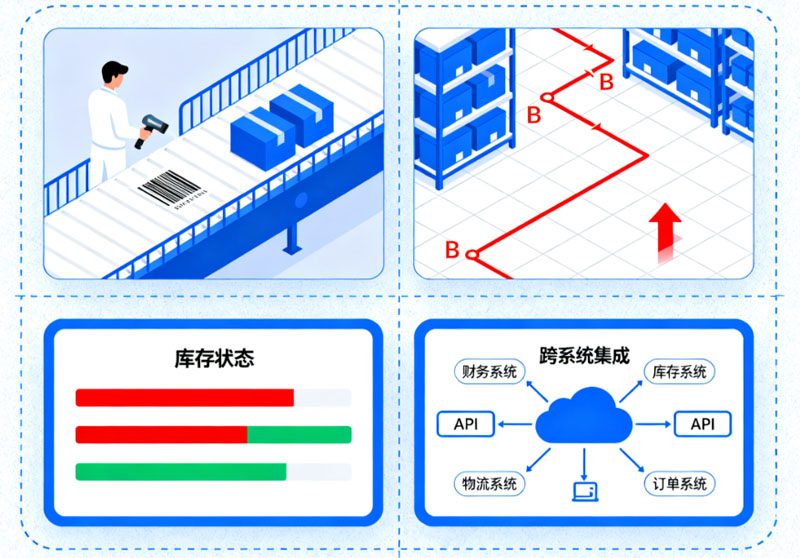
• Procurement Inbound: Automatically generate inbound orders linked to purchase orders. Warehouse staff scan codes via PDAs to verify goods information, and the system automatically checks data consistency. Upon successful verification, inventory is updated in real time, with key information such as inbound time and storage slots recorded to prevent incorrect or missing receipts.
• Return Inbound: Generate dedicated return inbound orders for customer or supplier returns. Support entry of inspection results; the system dynamically adjusts inventory based on inspection outcomes to standardize return workflows.
• Special Inbound: Flexible support for samples, gifts and other scenarios, enabling manual creation of inbound orders to accommodate diverse inbound business needs.
2. Outbound Management: Accurate Order Fulfillment & Efficient Collaboration
• Sales Outbound: Automatically generate outbound orders associated with sales orders. The system recommends optimal picking routes based on inventory levels and slot layout. Staff pick goods according to orders, scan codes via PDAs for double verification before packaging to guarantee outbound accuracy. Inventory is updated instantly upon completion, with feedback sent to the sales department to ensure timely order fulfillment.
• Transfer Outbound: Generate transfer orders for inter-warehouse transfers, enabling real-time tracking of goods transfer status for efficient cross-warehouse circulation.
• Special Outbound: Support manual creation of outbound orders for loss reporting, sample dispatch and other non-standard outbound scenarios.
3. Inventory Management: Real-time Visibility & Dynamic Risk Control
• Real-time Query: Multi-dimensional inventory data query with real-time data updates, eliminating manual statistics and ensuring transparent and precise inventory information.
• Intelligent Early Warning: Customizable upper and lower inventory thresholds. The system automatically sends notifications when stock falls below the minimum threshold or exceeds the maximum threshold, reminding staff to restock or clear excess inventory promptly.
• Flexible Stocktaking: Support periodic and ad-hoc stocktaking via PDA code scanning. The system automatically compares book records with physical stock and generates discrepancy reports to simplify stocktaking procedures.
• Slot Management: Standardized slot coding with intelligent slot allocation based on product attributes. Support slot inquiry, occupancy and release management to boost slot utilization.
4. Picking Management: Route Optimization & High Precision
• Automatic Picking List Generation: Generate picking lists based on outbound orders, clearly indicating product name, specification, quantity, storage slot and picking sequence to avoid blind searching by staff.
• Route Optimization: Algorithms calculate the shortest picking route based on warehouse slot layout, cutting staff walking distance and lifting picking efficiency by over 30%.
• Double Confirmation: Staff scan codes via PDAs to confirm upon picking completion, with secondary verification by inspectors to achieve zero picking errors.
5. Report Statistics: Data-driven Scientific Decision-making
• Comprehensive Core Reports: Generate inventory reports, operation reports and order reports to intuitively display warehouse operation data.
• Customizable Reports: Allow users to set report formats and statistical dimensions per business requirements, supporting personalized data analysis and providing data backing for management decisions.
6. Cross-system Integration: Break Data Silos to Realize Business Collaboration
• Seamless Connection with ERP Systems: Standardized APIs enable two-way real-time synchronization of purchase/sales orders and inventory data, eliminating duplicate manual data entry and unifying the business chain of "procurement – warehousing – sales".
• Linkage with CRM Systems: Retrieve information including customer order priority, delivery address changes and return reasons to optimize outbound scheduling and return handling, elevating customer service quality.
• Integration with TMS Systems: Automatically bind outbound orders with logistics tracking numbers and synchronize real-time goods delivery status for easy tracking by enterprises and customers.
7. Permission Control: Granular Authorization & Traceable Security
Adopt a "role-permission" mapping mechanism. System administrators assign exclusive permissions by position to align responsibilities with authorities. Granular permission control is available, and all user operations are automatically logged to facilitate audit and responsibility tracing, safeguarding system data security.
IV. Emergency Response Mechanisms: Ensure Business Continuity & Mitigate Operational Risks
In case of server failure or network outage, warehouse staff can complete basic operations including inbound processing, picking and stocktaking offline via PDAs. Offline data will be automatically synchronized once network connection is restored to avoid suspension of warehouse operations.
Adopt a dual backup model combining daily full backup and real-time incremental backup, with data synchronized to off-site servers for dual-layer data protection. In the event of data loss or corruption, files can be quickly restored from backups to guarantee zero data loss.
A professional technical team provides round-the-clock fault response services. We commit to responding to fault requests within 1 hour and delivering solutions within 4 hours to restore system operation rapidly and minimize operational disruptions caused by malfunctions.
 Public Security Filing Number:辽公网安备21060302000305号


