I. What Is the AI-Powered Intelligent Factory Production Control System?
When people think of factories, the common image is still one of roaring machinery, busy workers and experience-driven operations. Product quality relies on human visual inspection, production scheduling depends on veteran staff’s intuition, equipment is only repaired after breakdowns, production status remains opaque, and workshop safety relies entirely on manual patrols.
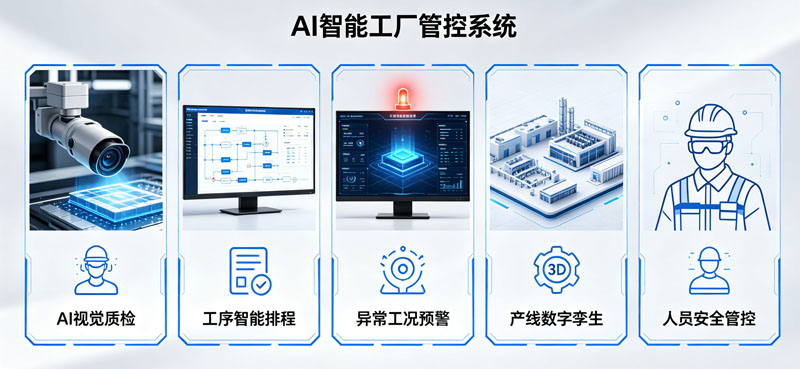
The AI-powered intelligent factory production control system equips traditional factories with an "intelligent brain, digital eyes and neural network". Integrating cutting-edge technologies including AI vision, big data, digital twins and the Internet of Things (IoT), it replaces experience-based factory management with data and artificial intelligence. Simply put, it enables automatic inspection, intelligent planning, early risk warning, visual management and intelligent safety protection. It transforms the extensive traditional production model into a refined, efficient, safe and worry-free modern smart manufacturing solution, applicable to most manufacturing sectors such as machinery, electronics, auto parts and light industry.
II. Five Core Capabilities: The Superpowers of an AI-Driven Factory
Traditional factory quality inspection fully relies on human labor. Long hours of staring at products lead to eye strain and reduced concentration, frequently resulting in missed or false detections. Inconsistent judgment standards among inspectors also cause uneven product quality.
AI quality inspection acts as a tireless, ultra-precise "electronic vision system" for factories. Equipped with high-definition industrial cameras and laser sensors paired with deep learning AI algorithms, it delivers full-process automatic inspection covering raw material incoming checks, in-process production and finished product delivery. It accurately identifies surface scratches, stains, deformations, tiny dimensional deviations, missing or misassembled parts and other defects.
Furthermore, the system grows smarter over time. Larger volumes of inspection samples boost its recognition accuracy, enabling it to adapt to inspection requirements for diverse products and processes with micron-level precision. It automatically records every defect and generates quality analysis reports to pinpoint problematic production stages, helping factories optimize processes and continuously reduce defective rates.
(2) Intelligent Production Scheduling: Eliminate Blind Production and Maximize Resource Utilization
Traditional factories often face recurring pain points: ad-hoc scheduling upon new orders leads to overloaded machinery alongside idle equipment; material shortages and process conflicts delay deliveries; manual scheduling is time-consuming and prone to errors.
The intelligent production scheduling module resolves these challenges completely. The system automatically aggregates all production data, including pending delivery orders, equipment health status, warehouse material inventory, staff rosters and product process specifications. AI calculates optimal production plans to rationally allocate machinery, labor and materials, avoiding process bottlenecks and resource waste.
In response to unexpected disruptions such as rush orders, sudden equipment malfunctions or material shortages, the system dynamically adjusts schedules without manual recalculation, rapidly resetting production rhythms to minimize downtime and ensure on-time order fulfillment, drastically lifting production efficiency.
Most traditional factories adopt passive equipment maintenance: staff only discover and repair faults after equipment breakdowns, production disruptions, excessive energy consumption or safety hazards occur. This results in production halts, material waste, delayed delivery and potential safety incidents.
The system delivers 24/7 all-weather intelligent monitoring. Various sensors and AI devices collect real-time data including equipment temperature, operating speed, production parameters, workshop environment and energy consumption. AI analyzes the data continuously to identify hidden risks such as equipment overload, process jams, material shortages and abnormal energy usage.
Once anomalies are detected, the system triggers instant alerts via pop-up windows, sound-light alarms and mobile push notifications, clearly indicating fault locations, problem types and basic troubleshooting suggestions. It enables early warning, rapid response and full traceability, eliminating production failures and risks at the source to stabilize production lines.
(4) Production Line Digital Twin: Virtual Factory Replication for Full Production Visibility
Traditional factory managers rely solely on reports and manual briefings to grasp production status, resulting in opaque workshop operations and blind spots in management. Process optimization and production line renovation rely largely on guesswork.
The digital twin module creates a 1:1 3D virtual replica of the factory, fully reconstructing real-world equipment, workstations, production lines and warehouse layouts on visual large screens. Critically, the virtual model synchronizes in real time with physical production lines, updating live data on production progress, equipment status, quality inspection results and material circulation.
Managers can obtain a full overview of factory operations remotely without on-site patrols. The system also supports simulation and deduction: new process trials, production line adjustments and capacity expansion can be tested virtually in advance to predict production bottlenecks and avoid renovation risks. All production records are traceable and reviewable, turning vague production management into transparent, precise and controllable oversight.
(5) Personnel Safety Control: Intelligent Monitoring to Secure Production Safety
Factory safety is a top priority, yet manual patrols inevitably have blind spots. Worker violations such as failure to wear protective gear, unauthorized entry into high-risk zones and improper equipment operation easily trigger safety accidents.
Leveraging AI visual recognition and personnel positioning technology, the system builds an all-round intelligent safety protection network. It automatically identifies violations including missing safety helmets, inadequate protective equipment, improper equipment operation and unauthorized access to restricted areas, capturing real-time alerts and archiving records to eliminate safety risks caused by human negligence.
It also supports real-time staff positioning and trajectory tracking for full intelligent supervision of high-risk operations such as high-altitude work. The system automatically compiles safety compliance statistics and generates safety reports to standardize factory safety management systems and reduce accident risks at the source.
III. Key Advantages of the Intelligent System
1. One-Stop Full-Process Control: Integrates quality inspection, scheduling, early warning, simulation and safety management modules, breaking data silos and disconnected workflows in traditional factories to deliver unified full-lifecycle production management.
2. Self-Learning and Self-Upgrading: AI algorithms continuously learn from production data. The system automatically adapts to new product launches, process upgrades and production line adjustments without frequent manual configuration, delivering exceptional compatibility.
3. Cost Reduction and Efficiency Improvement: Automates repetitive manual work including quality inspection, scheduling and patrols to cut labor costs. It also lowers defective rates, equipment failure rates and delivery delays while boosting overall output capacity.
4. Eliminate Experience-Driven Management: Visual large screens and big data analytics deliver real-time production visibility, shifting management decision-making from experience-based judgment to data-driven precision.
5. Full-Lifecycle Safety Risk Control: 24/7 intelligent monitoring of personnel safety and equipment conditions mitigates production hazards comprehensively, safeguarding stable and compliant factory operations.
IV. Implementation Value: Enabling Intelligent Transformation for Traditional Factories
Simply put, this AI production control system acts as an upgrade catalyst for traditional manufacturing enterprises. It addresses core pain points of conventional factories including low efficiency, unstable product quality, pervasive safety hazards, opaque management and backward digital infrastructure. It helps factories achieve standardized production, intelligent control, data visualization and standardized safety protocols.
Comprehensive AI empowerment optimizes production processes, rationalizes resource allocation, rigorously controls product quality and mitigates safety risks. Beyond direct cost reduction, quality improvement and output growth, it supports manufacturing enterprises in completing digital and intelligent transformation, strengthening their competitive edge in the industry.
 Public Security Filing Number:辽公网安备21060302000305号


