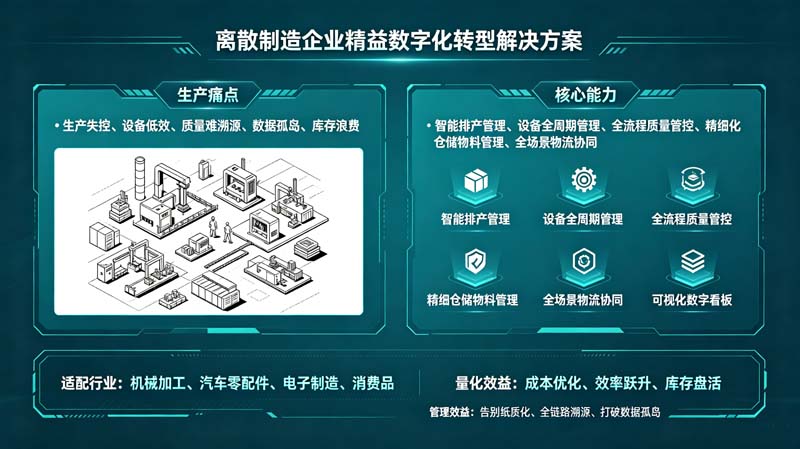
Digitalization, lean management and intelligent manufacturing have become the core drivers for the transformation and upgrading of the manufacturing industry. At present, most discrete manufacturing enterprises are still trapped in extensive manual management, plagued by numerous challenges including out-of-control production, inefficient equipment, untraceable quality, data silos and inventory waste. These issues make it impossible for them to adapt to the modern production model featuring multi-variety, small-batch and fast iteration.
Targeting the core pain points at the workshop execution layer of manufacturing enterprises, our exclusive digital solution focuses on full-process workshop control, breaks down data barriers between the planning layer and on-site operation layer, and integrates all business chains including production, equipment, quality, materials, inventory and logistics. It helps enterprises build visual, intelligent and lean digital workshops, and ultimately achieves cost reduction, quality improvement, efficiency enhancement and industrial transformation.
Applicable Industries: All categories of discrete manufacturing including machinery processing, auto parts, electronic manufacturing and consumer goods.
I. Uncover the Root Causes of Profit Drain in Discrete Manufacturing Plants
1. Chaotic production planning leading to low delivery efficiency
Manual scheduling lacks flexibility. Frequent order insertions and line changeovers easily trigger process disorder and material waste. Production progress and output rely on manual statistics without intelligent early warning mechanisms, resulting in inaccurate delivery date prediction and frequent order delays.
2. Extensive equipment management causing severe resource waste
There is no standardized operation and maintenance system for equipment, leading to long-term reactive breakdown repairs, frequent malfunctions and low equipment utilization. Management of tooling, molds and spare parts is disorganized, making it impossible to accurately calculate Overall Equipment Effectiveness (OEE) and identify production bottlenecks.
3. Weak quality control with difficult traceability and accountability
Quality inspection depends on manual recording and verification, which brings high error rates and loose workflows. Confused product batch management and incomplete retention of process parameters hinder rapid traceability of defective products and precise accountability, making it hard to optimize production processes iteratively.
4. Lagging material and logistics management with prominent data silos
Manual material scheduling is inefficient and fails to meet flexible production demands. Data from various business systems are isolated, resulting in messy inventory accounts and cumbersome stocktaking. Enterprises commonly face dual troubles of production shutdown due to material shortages and excessive material backlogs, tying up large amounts of capital in inventory.
5. Lack of data management leading to blind decision-making
Energy consumption and production data are only counted as aggregate figures without breakdown by production lines and batches. Manual entry of full-process data is error-prone and delayed, leaving management without accurate data support and resulting in blind production decisions.
II. Six Core Capabilities to Restructure Lean Workshop Production Systems
1. Intelligent Production Scheduling for Efficient and Controllable Production
Seamlessly connect ERP production plans, intelligently split work orders and allocate process and equipment tasks based on Bill of Materials (BOM) to support coordinated production across multiple processes and stations. Track the full lifecycle status of work orders in real time, automatically collect data on manpower, machines, materials and consumption to realize paperless intelligent work reporting. Support full-dimensional traceability to completely resolve confusion caused by order insertions and data loss, and greatly improve order delivery accuracy.
2. Full-Lifecycle Equipment Management to Reduce Malfunctions and Boost Productivity
Establish electronic equipment files to standardize the management of equipment information, maintenance records and ownership changes. Collect real-time equipment operating parameters via the Internet of Things (IoT) and trigger automatic alerts for abnormalities. Standardize closed-loop online workflows for daily inspections, maintenance and repairs. Intelligently calculate OEE to shift from reactive breakdown repairs to predictive maintenance, effectively lifting equipment utilization rates.
3. Full-Process Quality Control: Shift from Post-Mortem Remediation to Pre-emptive Prevention
Cover all quality inspection scenarios including incoming inspection, in-process inspection, outbound inspection and inventory random sampling, with customizable inspection standards and frequencies. Automatically freeze defective products and trigger intelligent alerts to quickly trace root causes and identify affected batches. Generate visual quality reports automatically linked to multi-dimensional production data, assisting enterprises in process optimization and defective product loss reduction.
4. Refined Warehouse & Material Management to Cut Inventory and Secure Production
Classify warehouses, storage zones and bin locations hierarchically to digitalize the entire process of material inbound/outbound, transfer and stocktaking. Set safety inventory thresholds with automatic shortage alerts to eliminate inconsistent book and actual inventory and disorganized stock. Implement one-code traceability for each material to enable intelligent line-side warehouse scheduling and precise error-proof feeding, reduce material backlogs and capital occupation, and guarantee uninterrupted production.
5. Full-Scenario Logistics Collaboration to Break Supply Chain Barriers
Cover all procurement and sales logistics scenarios, intelligently generate logistics plans and complete inbound/outbound operations efficiently via barcode scanning. Separate internal and external logistics management, retain complete logistics documents, and build a full-chain supply chain traceability system to drastically improve logistics scheduling efficiency across factories and cooperative partners.
6. Visual Digital Kanban for Full Visibility of Workshop Status
Integrate five visual modules covering production, equipment, quality, energy consumption and comprehensive management, displaying core indicators such as output, equipment status, inspection results and energy data in real time. Pop-up alerts for abnormal data enable on-site staff and management to grasp the overall workshop situation instantly for rapid responses and precise decision-making.
(I) Quantifiable Benefits: Hard Improvements Validated by Data
1. Significant cost optimization: Overall enterprise total cost reduced by up to 50%, labor costs down 42%, assembly costs cut by 45%, and consumable expenses lowered by 73%.
2. Surge in production efficiency: Product assembly time reduced by 60%, process optimization efficiency improved by 53%, new product R&D cycle shortened by 45%, overall workshop capacity increased by 10%–15%, and production waste cut by 5%–8%.
3. Optimized inventory utilization: Greatly accelerated stocktaking efficiency, thorough resolution of material shortages and backlogs, liberated working capital and stabilized production rhythms.
(II) Managerial Benefits: Lean Upgrading to Strengthen Competitiveness
1. Eliminate paper-based workflows and errors from manual statistics; full-process production data is synchronized in real time with authentic and reliable records.
2. Achieve full production chain traceability for rapid problem localization and iterative process optimization, consolidating product quality.
3. Break down data silos and realize integrated collaborative management across production, supply, sales and R&D departments.
4. Drive the transformation from traditional extensive production to flexible, lean and intelligent manufacturing, comprehensively enhancing enterprises’ market responsiveness and core competitiveness.
 Public Security Filing Number:辽公网安备21060302000305号


