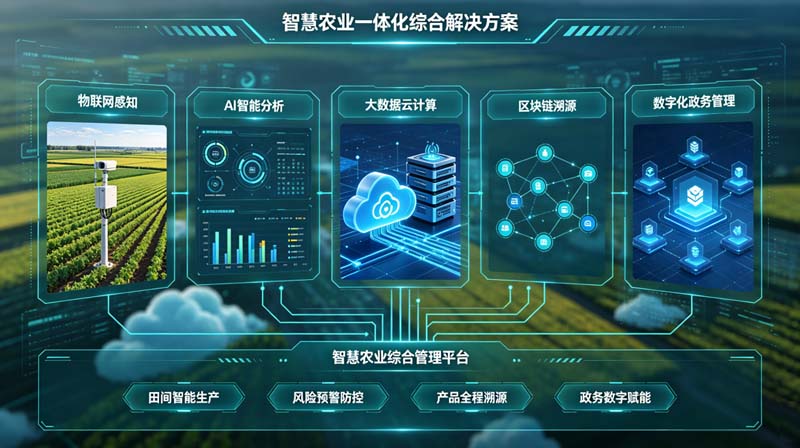
Targeting industrial pain points including extensive management of traditional agricultural production, low resource utilization, passive pest and disease prevention and control, inadequate supervision of agricultural product quality, and non-standard management of agricultural subsidies, this solution integrates core technologies such as IoT perception, AI intelligent analysis, big data cloud computing, and blockchain traceability. It builds an integrated smart agriculture comprehensive management platform covering intelligent field production, risk early warning and prevention, full-process product traceability, and digital government empowerment. The platform consists of six core business systems with interconnected data and coordinated business operations across all modules. It realizes refined agricultural production, intelligent management, digitalized services and transparent supervision, and comprehensively boosts agricultural quality improvement and efficiency growth, green production and digital rural revitalization.
I. Overall Architecture Design
This smart agriculture solution adopts a layered architecture, divided from bottom to top into the Perception Layer, Transmission Layer, Platform Layer and Application Layer, accompanied by a supporting security guarantee system and operation & maintenance system to ensure stable and efficient system operation.
1. Perception Layer: Deploys various field sensors, monitoring equipment and collection terminals to realize all-round data collection of farmland environment, crop conditions, pest conditions and soil moisture.
2. Transmission Layer: Relies on 5G, NB-IoT and wireless IoT technologies to deliver low-latency and highly stable data transmission.
3. Platform Layer: Constructs a cloud-based big data middle office to complete data cleaning, storage, analysis, modeling and linkage scheduling.
4. Application Layer: Delivers functions of six core business systems for four types of users including growers, agricultural cooperatives, regulatory authorities and consumers, covering all scenarios of agricultural production, circulation, supervision and services.
II. Technical Solutions for Core Systems
(1) Intelligent Soil Moisture Monitoring System
This system addresses the challenges of high manual labor costs, delayed data, single monitoring dimensions and insufficient support for precision planting in conventional soil monitoring. Supported by IoT sensing technology and big data analysis models, it achieves all-weather, automatic and high-precision monitoring of farmland soil environment.
The system supports collection of multi-dimensional core soil indicators, including soil moisture, temperature and humidity, pH value, electrical conductivity, as well as nitrogen, phosphorus, potassium and other nutrient parameters. Terminal devices are compatible with diverse planting scenarios such as open farmlands, greenhouses and hilly plots, featuring outdoor adaptability with waterproof, lightning-proof, high-temperature resistant and anti-corrosion properties for long-term stable field operation.
After data is transmitted to the cloud middle office, the system automatically completes data denoising, calibration and screening. Combined with growth cycles, crop varieties and regional environmental parameters of different agricultural products, it builds an intelligent soil moisture judgment model to accurately identify abnormal conditions such as soil drought, waterlogging, nutrient imbalance and excessive acidity/alkalinity. Meanwhile, it generates plot-level soil moisture data reports and regional soil moisture thermal distribution maps to realize grid-based and refined soil management, providing accurate real-time data foundation for subsequent intelligent water and fertilizer regulation, planting scheme optimization and cultivated land quality assessment.
(2) Intelligent Integrated Water and Fertilizer Regulation System
To tackle the problems of water waste, low fertilizer utilization efficiency, damaged soil ecology and uneven crop quality caused by flood irrigation and blind fertilization in traditional agriculture, the system establishes an AI intelligent water and fertilizer decision model based on soil moisture data, meteorological environment data and crop growth data. It delivers a green planting mode featuring on-demand irrigation, precision fertilization, proportional dosing and automatic control.
The core of the system falls into two modules: intelligent decision-making and automatic linkage control.
• The decision-making module integrates multi-dimensional data including real-time soil conditions, weather temperature and humidity, crop growth stages and plot moisture thresholds, and intelligently calculates irrigation volume, fertilizer type, mixing concentration and application duration for individual plots to eliminate experience-based farming operations.
• The control module can seamlessly connect with full sets of field water and fertilizer equipment including water and fertilizer integrated machines, electromagnetic valves, drip irrigation and sprinkler irrigation systems. It supports three operation modes: fully automatic intelligent operation, remote manual control and timing semi-automatic operation to meet diverse planting management demands.
In addition, the system automatically counts water and fertilizer consumption, resource utilization rates and input-output data, and generates standardized water and fertilizer management ledgers. It effectively cuts planting production costs, reduces agricultural non-point source pollution, and achieves green agricultural production goals of water & fertilizer conservation, yield and quality improvement.
(3) Intelligent Crop Growth Analysis System
Supported by machine vision, UAV remote sensing, satellite imagery and big data AI algorithms, the system replaces traditional manual patrol inspection. It solves industrial pain points such as low efficiency and strong subjectivity of conventional growth monitoring, as well as incapability of large-scale accurate evaluation, enabling dynamic monitoring, intelligent analysis and trend prediction of crops throughout the entire growth cycle.
The system collects full-coverage farmland images via field high-definition cameras, UAV aerial photography and satellite remote sensing. Deep learning image recognition algorithms automatically extract core growth characteristics including crop height, leaf area index, tiller quantity, vegetation coverage and leaf status. A standard growth database covering all crop varieties and full growth cycles is established. Real-time collected data is intelligently compared with standard thresholds to accurately judge crop growth conditions such as excellent, normal, weak, excessive growth and premature senescence.
Combined with historical data of soil, water & fertilizer and meteorology, a growth prediction model is built to forecast crop growth trends and expected yields. Targeted refined conditioning plans for water control, fertilizer supplementation, ventilation and plant protection are automatically pushed for plots with abnormal growth, providing intelligent support for farm scheduling, field management, yield estimation and harvest guarantee.
(4) Intelligent Pest & Disease Early Warning and Prevention System
Shifting from the passive post-outbreak treatment model of traditional pest and disease control, the system constructs an intelligent prevention and control system featuring early warning, precise identification, scientific management and full-process traceability. It effectively mitigates risks of agricultural output reduction arising from sudden outbreaks, rapid spread, delayed treatment and excessive pesticide use, and safeguards safe agricultural production.
The system integrates pest monitoring equipment, environmental sensors and AI visual recognition terminals to collect real-time data on pest species, pest density, field temperature, humidity, light and other inducing factors of pests and diseases. Trained on massive sample databases of crop pests and diseases, deep learning algorithms can automatically identify common fungal, bacterial and insect pests, accurately locate affected areas, determine hazard levels and spread risks.
A graded early warning model is built based on historical pest outbreak patterns and real-time environmental data, pushing warning information at three levels: general, moderate and severe. Corresponding green and precise prevention plans are simultaneously matched to guide standardized and scientific pesticide application, cut pesticide dosage, boost pest and disease control efficiency and maintain healthy crop growth.
(5) Full-Chain Agricultural Product Traceability System
Addressing market pain points such as opaque agricultural production, unrecorded circulation, untraceable quality, lack of liability basis and failure to realize premium prices for high-quality products, a full-life-cycle traceability management system covering planting, processing, warehousing, circulation and sales is developed. It enables full lifecycle inquiry, traceability, accountability and supervision of agricultural products from farmland to dining tables.
The system automatically links front-end production data to fully record source production information including plot details, soil moisture data, water and fertilizer application records, pest and disease prevention logs, daily farming operations and harvest time. Processing links input data of sorting, quality inspection, packaging and production workflows; warehousing and circulation links record storage environment, logistics trajectories and turnover information; sales links bind sales channels and shelf information.
A unique tamper-proof traceability QR code is generated for each batch and each piece of agricultural products, allowing consumers to view full-process traceability information with one scan. A dedicated traceability management backend is open to regulatory authorities for quality verification, traceability and accountability of defective products as well as brand qualification inspection, facilitating agricultural product brand building and improving market credibility and product added value.
(6) Digital Agricultural Subsidy Management Software
To resolve the drawbacks of cumbersome application procedures, low manual audit efficiency, poor verification accuracy, opaque data, fraudulent claims and inadequate supervision in traditional agricultural subsidy management, a fully digital, standardized and transparent agricultural subsidy management system is developed. It realizes online processing of the entire workflow including policy release, application, review, verification, disbursement and supervision of subsidies.
The software integrates seven core functions: policy publicity, online application, intelligent verification, multi-level review, disbursement supervision, data statistics and electronic ledgers, fully adapting to various agricultural supportive policies such as planting subsidies, agricultural machinery subsidies and special agricultural subsidies. Farmers, cooperatives and agricultural enterprises can complete form filling and applications online without offline paperwork.
By interfacing with farmland right confirmation databases, planting monitoring databases and farmer information databases, intelligent comparison algorithms automatically verify the authenticity and compliance of application information, replacing traditional on-site manual verification and greatly improving audit efficiency and accuracy. A standardized and transparent online multi-level review process covering village, township and county levels is established. All operation data is retained throughout the process, with automatic generation of electronic ledgers supporting data publicity, traceability inquiry and abnormal risk early warning. It effectively eliminates false, omitted and erroneous applications, ensuring precise implementation and standardized disbursement of agricultural subsidies.
III. Application Value and Achievements of the Solution
The implementation of this integrated smart agriculture solution can empower the transformation and upgrading of modern agriculture in an all-round manner:
1. Production Level: Effectively improve water and soil resource utilization, reduce manual and material costs for planting, cut losses caused by pests and diseases, and significantly raise crop yield and quality.
2. Industrial Level: Break barriers in production and marketing information, build high-quality agricultural product brands, and strengthen market competitiveness of agricultural products.
3. Government Administration Level: Simplify processing procedures for agricultural subsidies, improve the efficiency of agricultural government services and standardization of supervision.
4. Industrial Sector Level: Drive the transformation of traditional extensive agriculture into digital, intelligent, refined and green modern agriculture, and provide core technical support for rural revitalization and agricultural modernization.
 Public Security Filing Number:辽公网安备21060302000305号


