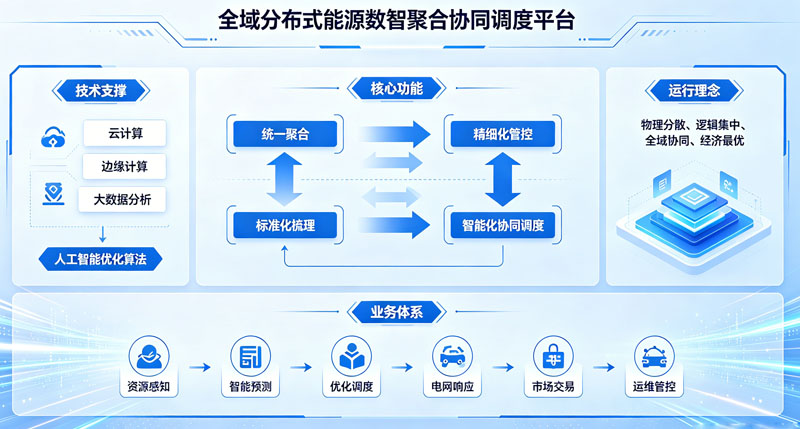
Against the backdrop of the rapid development of new power systems, distributed photovoltaics, distributed wind power, energy storage equipment, intelligent charging piles, industrial and commercial flexible loads and other distributed energy resources have been widely deployed on a large scale. However, such resources are scattered geographically, diverse in equipment types and variable in operating conditions. Long operating in an isolated state, they give rise to numerous industry pain points, including disordered grid connection, weak regulation capacity, low new energy consumption rates, limited access to market-oriented transactions, and insufficient collaborative utilization of resources.
To address the above challenges, the Virtual Power Plant Collaborative Scheduling Platform leverages cutting-edge digital technologies such as cloud computing, edge computing, big data analytics and AI optimization algorithms to uniformly aggregate, standardize, refine and intelligently coordinate the scheduling of all scattered distributed energy resources. Breaking the bottleneck of isolated operation of traditional distributed energy, the platform adheres to the core operation philosophy of "physical decentralization, logical centralization, global coordination and economic optimality", and builds a full-process business system covering resource perception, intelligent forecasting, optimized scheduling, power grid response, market trading and operation & maintenance management. It not only safeguards the safe and stable operation of power grids and boosts new energy consumption capacity, but also helps all energy consumers cut costs and improve efficiency, facilitating the green and low-carbon transformation and upgrading of the energy sector by delivering a systematic solution with strong implementability and flexible scalability.
I. Platform Positioning and Construction Value
Closely aligned with the core requirements for developing new power systems, the platform integrates all types of adjustable distributed energy resources across regions to build a smart energy scheduling hub integrating aggregated resource management, intelligent collaborative scheduling, grid auxiliary services, power market-oriented trading, lean energy efficiency operation & maintenance, and intelligent data analysis. It thoroughly transforms the traditional model of scattered grid connection and passive control for distributed energy, upgrading it to a new paradigm of large-scale aggregation, active regulation and market-oriented operation. Featuring global resource coordination, multi-scenario adaptability, multi-stakeholder win-win outcomes and high safety and reliability, the platform meets the energy scheduling and operational demands of diverse users and scenarios.
II. Core Functional Modules of the Platform
Distributed energy equipment available on the market varies widely in categories, parameters and geographic distribution, resulting in unclear resource inventories, difficult control and poor coordination. To tackle this pain point, the platform carries out standardized modeling and sorting of heterogeneous distributed energy resources including photovoltaics, wind power, energy storage, charging piles and flexible loads.
The system establishes complete electronic equipment ledgers, resource information archives and equipment topological relationships, alongside a sound adjustable capacity evaluation system to realize unified classification, coding and control of all energy equipment. It also supports secure equipment access authentication, 24/7 online monitoring of operating status, real-time calculation of adjustable capacity and dynamic updates of resource information. The platform can accurately tally the overall scale, response speed, regulation range and real-time operating status of globally schedulable energy, providing authentic, precise and comprehensive basic data support for subsequent intelligent scheduling and transaction settlement.
The output of new energy sources such as wind and photovoltaic power is highly susceptible to weather and seasonal changes, while electricity loads dynamically shift with time periods and manufacturers’ production schedules. Such uncertainties constitute the primary difficulty in energy scheduling. Based on machine learning and time-series prediction algorithms, the platform integrates multi-dimensional data including meteorological information, seasonal patterns, time-of-day characteristics, historical equipment operation data and user energy consumption habits to build high-precision intelligent forecasting models.
It delivers core forecasting functions including distributed photovoltaic and wind power output prediction, industrial, commercial and residential electricity load forecasting, and time-of-use electricity price trend forecasting, supporting multi-period rolling forecasts for day-ahead, intra-day and real-time horizons. By predicting in advance fluctuations in new energy output and changes in user load, the platform effectively avoids scheduling imbalance risks stemming from the randomness and intermittency of new energy, and furnishes reliable data support for formulating collaborative scheduling strategies, responding to grid dispatch orders and precise market bidding.
As the core business module of the platform, this module establishes a multi-dimensional intelligent optimized scheduling model subject to fundamental constraints of safe grid operation, rational energy consumption by users and secure equipment operation. Moving beyond conventional single-mode scheduling, it simultaneously optimizes multiple core objectives: safe power grid operation, maximum new energy consumption, minimum user energy costs, maximum comprehensive revenue and optimal carbon emissions.
Adaptable to mainstream application scenarios including peak shaving and valley filling, grid frequency regulation, emergency reserve, demand response, new energy consumption and park energy self-sufficiency, the module iteratively optimizes AI algorithms to automatically generate scientific and reasonable strategies for energy storage charging and discharging, flexible user load adjustment, optimized new energy output and orderly charging management for charging piles. It achieves precise coordination and dynamic balance among power sources, loads and energy storage across the whole region. Meanwhile, a closed-loop scheduling control mechanism is deployed to collect real-time equipment execution data, rollingly revise scheduling strategies and continuously enhance scheduling accuracy and adaptability.
The platform enables seamless interconnection with superior grid dispatching systems to receive real-time, accurate dispatch orders issued by power grids for peak regulation, frequency regulation, voltage regulation, emergency load control, demand response and other services. The system rapidly disassembles orders, splits tasks and precisely distributes them to edge nodes as well as terminal power generation, energy storage and power consumption equipment, enabling coordinated linkage responses of all distributed energy resources across the region.
It boasts full-process capabilities including intelligent parsing of grid orders, accurate task matching, rapid resource scheduling, whole-process monitoring of execution, real-time feedback of results and quantitative evaluation of response effects. It can efficiently support the implementation of various grid auxiliary services, and effectively improve the operational stability, flexibility and fault tolerance of regional power grids.
(V) Power Market Trading & Settlement Module – Unlocking Resource Value for Transparent Operation
Fully compatible with the rules of China’s mainstream markets including power spot markets, grid auxiliary service markets, demand response markets and carbon trading markets, the platform delivers full-process market-oriented service capabilities covering transaction declaration through revenue settlement. Its complete functions include intelligent market bidding, transaction clearing and matching, full-cycle transaction execution, multi-dimensional data statistics, precise cost accounting, revenue split settlement and traceable transaction assessment.
By aggregating fragmented, small-scale distributed energy resources into large-scale, standardized market trading entities, the platform enables scattered energy assets that were previously excluded from power and carbon markets to participate in market-oriented transactions. It can also accurately calculate the contribution of each terminal device and each category of resources, ensuring transparent transaction workflows and refined, precise revenue settlement. This maximizes the market value of distributed energy and boosts asset returns for users.
Based on GIS geographic information maps, the platform builds a global energy visual monitoring screen that intuitively displays core data including equipment geographic distribution, real-time operating status, power generation output, user load variations, scheduling execution status and market transaction metrics. It supports query of operation curves, review of historical data and multi-dimensional statistical analysis, allowing operation and maintenance personnel to gain a full overview of regional energy operation without cumbersome operations.
In addition, a hierarchical and classified intelligent alarm mechanism is established to trigger real-time early warnings, trace root causes and compile fault statistics for risk conditions such as equipment failures, power over-limit, scheduling execution deviations, communication anomalies and data abnormalities. This enables operation and maintenance staff to quickly locate and resolve faults, drastically cutting operation and maintenance costs and comprehensively improving the operational reliability of the platform and terminal equipment.
 Public Security Filing Number:辽公网安备21060302000305号


